 Stake
Stake
Stake withdrawals follow exit rules, while token sales depend on market liquidity
Stake withdrawals release eligible funds when a position meets its exit requirements and the network or provider completes the transfer. Native staking may require unbonding, a cooldown or a validator exit before funds become spendable. Liquid staking can offer redemption of receipt tokens or their sale on a secondary market. Redemption follows the pool’s funding and settlement rules; a sale follows available liquidity and execution terms. A waiting estimate can change even when the eligibility rule stays the same. The choice rests on the balance you control, the asset you want to receive and the cost of each supported exit.
The short version: A market sale depends on trading liquidity, while redemption depends on the withdrawal mechanism’s eligibility and settlement conditions.
Waiting rules and changing withdrawal demand
A mandatory unbonding period sets an eligibility requirement; queue demand and available redemption funds influence the estimated completion time. During unbonding or cooldown, the affected funds can remain unavailable for spending. A validator exit can involve a queue before participation ends. A chain’s staking parameters specify its unbonding duration, while an unbonding entry can record its own completion time. A dashboard estimate can also reflect changing processing delays. Network governance or upgrades can change withdrawal parameters, so the rules governing the existing position matter when interpreting its recorded timing.
A separate lockup can restrict withdrawal even after stake becomes inactive, and an elapsed cooldown does not override that restriction. Pool liquidity or queue processing can add delays beyond a minimum waiting requirement. An eligibility date alone therefore need not predict delivery. Some methods require settlement or a claim after the waiting condition ends.
Which exit path matches the balance you hold?
A native balance follows its network’s spending and release rules, while a transferable staking token can offer redemption or sale where those paths exist. Some delegation models keep the delegated coins spendable, so those coins do not require unbonding. Other native positions restrict spending until their exit conditions allow release. A delegation record can represent accounting shares without creating a tradable token. With custodial staking, the provider operates the withdrawal process and credits its customer account; that internal balance follows the provider’s release options.
Where a pool offers redemption, its contract defines the tokens it accepts and the asset it releases. Some contracts separate the initial request from finalization and a later claim. Available pool funds can support settlement without a new validator exit for every redemption. The relevant constraints concern accepted inputs, funding and claim eligibility, alongside any upstream network withdrawal conditions.
A market sale requires a transferable token and available trading liquidity. It exchanges the token for the chosen output asset at executable market terms. Tokens committed elsewhere may need release first. If a staking token secures an outstanding loan, withdrawing that collateral must satisfy the lending position’s requirements. Repaying debt or supplying additional collateral may change how much the lending protocol permits you to remove.
What confirms a withdrawal has reached the receiving account?
A completed release record and the corresponding receiving balance establish delivery; a pending request or a claimable amount establishes an earlier state. Match the asset, amount and recipient to the release. For custody services, an internal balance credit proves receipt within the provider account. It does not establish a transfer to an external wallet.
Continue a queued redemption or wait
Consider a recorded redemption whose contract reserves funds on finalization and requires a separate claim.
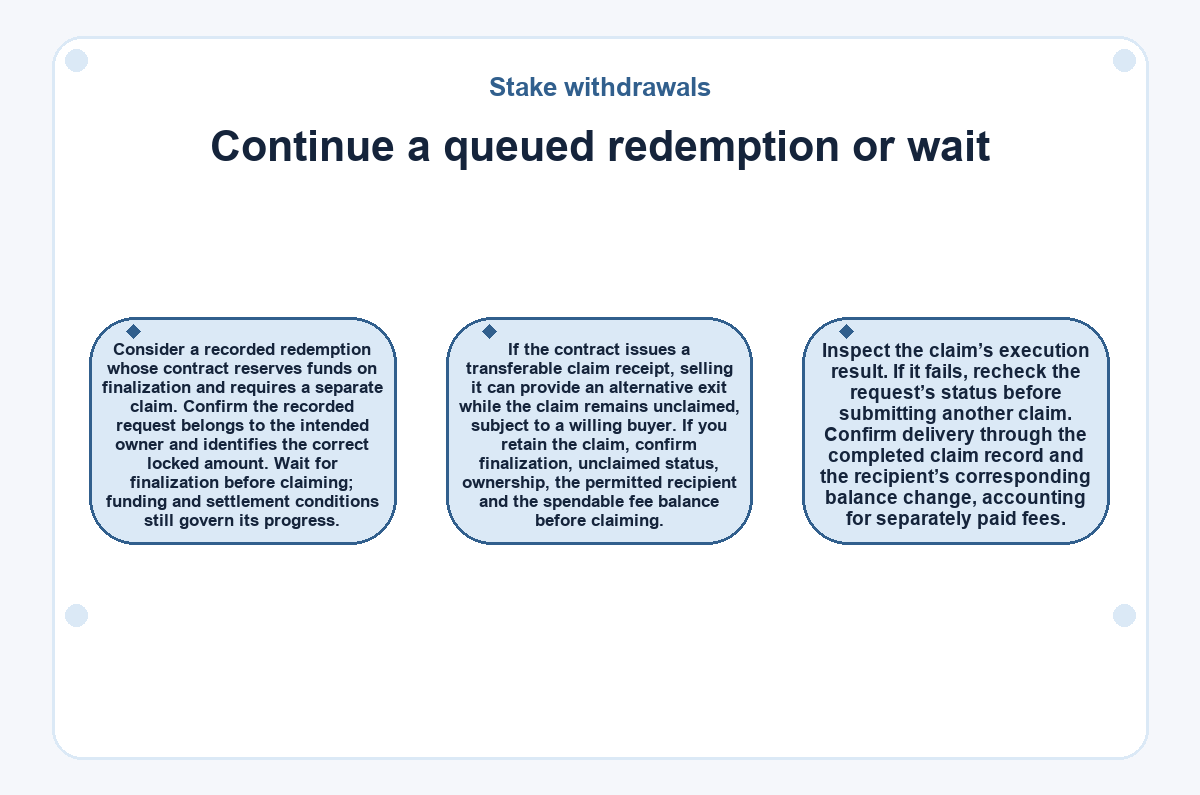
- Confirm the recorded request belongs to the intended owner and identifies the correct locked amount.
- Wait for finalization before claiming; funding and settlement conditions still govern its progress.
- If the contract issues a transferable claim receipt, selling it can provide an alternative exit while the claim remains unclaimed, subject to a willing buyer.
- If you retain the claim, confirm finalization, unclaimed status, ownership, the permitted recipient and the spendable fee balance before claiming.
- Inspect the claim’s execution result. If it fails, recheck the request’s status before submitting another claim.
- Confirm delivery through the completed claim record and the recipient’s corresponding balance change, accounting for separately paid fees.
Rewards, penalties and fees during an exit
The amount available after exit depends on the recorded balance, applicable deductions and the point when the selected method stops attributing staking rewards. Some withdrawal queues stop allocating rewards to the requested amount when the request begins. Other methods retain reward eligibility until participation actually ends. Distinguish amounts already earned from estimates for future periods. Releasing principal does not establish another reward payment. Pending settlement can also leave the final redemption amount subject to the protocol’s accounting rules. A request amount and a final claimable amount can therefore differ.
Some protocols retain liability during unbonding for validator offences committed while the funds were bonded.
Network transaction fees, redemption charges and trading fees belong to different actions. An automatic protocol distribution may require no user transaction; an explicit claim generally does. Keep a spendable fee balance where a later action needs one. A fee paid from a separate wallet balance reduces that balance without necessarily reducing the withdrawal amount, so include it when comparing release costs.
A withdrawal can deliver the expected quantity after its market value has changed.
Does selling a staking token end the underlying stake?
Selling a transferable staking token changes its holder; the trade itself does not require the validators behind that token to exit staking. The seller exchanges the sold portion of the position for another asset. The buyer acquires the token’s associated exposure and redemption rights under its rules, while the seller’s remaining tokens retain their exposure. This separates a holder’s market exit from a protocol withdrawal, even when both paths can produce the same output asset.
A liquid staking token can trade below its protocol redemption value. In a liquidity pool, trade size relative to available liquidity influences price impact. Slippage describes the difference between expected and actual execution terms. A swap with an enforced minimum-output condition fails if it cannot meet that minimum. Relaxing that condition permits a worse fill without adding liquidity or reducing price impact.
Native withdrawals and accelerated provider releases
Whether an exit releases part of a position, ends a validator’s participation or credits a provider balance depends on the selected method.
Native position exits
Partial releases
Some protocols automatically release eligible excess balances while the validator continues participating. Requested partial withdrawals can also exist under specific balance and credential conditions. Some delegation systems permit splitting a position and deactivating only the selected portion, leaving the other portion active.
Full validator exits
A full validator exit ends that validator’s participation under the network’s exit rules. The operator may still owe duties until the exit becomes effective. Release can then require a further eligibility delay and automatic processing. Staking management and withdrawal control can involve different authorities, whose recorded permissions govern ending participation, releasing funds and determining the destination.
Provider balance credits
Some custodial services offer standard unstaking alongside an accelerated release for a fee. The accelerated option can depend on eligibility or live availability. A provider balance credit makes funds available within that account, subject to its controls. Sending those funds to a separate wallet adds the provider’s transfer requirements. When the service deducts its fee from the release, the net credit equals the gross amount minus that fee.
Stake withdrawals - your questions answered
Does transferring a withdrawal receipt change who can claim the funds?
Transferring a withdrawal receipt changes the claim owner when that receipt represents a transferable withdrawal right under the contract’s rules. The new owner must still satisfy finalization and claim requirements. Moving the receipt does not deliver the underlying asset or remove its waiting conditions. An ordinary request identifier alone does not establish a transferable right.
Can a higher transaction fee shorten an unstaking queue?
A higher network transaction fee does not advance an already recorded request in a queue ordered by request creation. Fee bidding can influence transaction inclusion where the network uses that mechanism. It does not override unbonding eligibility or queue ordering. An accelerated provider release is a separate service with its own availability and charges.
Which token units determine a redemption minimum?
The redemption method defines the units it uses to test its minimum amount. A wrapped staking token can represent a different quantity of its underlying token. Some contracts test the converted amount and reject the request if it falls below their minimum. Compare the converted amount with the contract’s threshold rather than assuming the displayed wrapper quantity uses the same denomination.
Do finalized withdrawal requests need separate claim transactions?
Some withdrawal contracts support batch claims for multiple finalized requests. The selected method must support batching, and every included request must meet its claim conditions. Ownership requirements still apply to each request. A dashboard offering only individual claims does not establish whether the underlying contract also supports a batch operation.
What permission does a staking token approval grant?
For a token using spending allowances, approval lets the designated spender move tokens up to the permitted amount. It does not itself request or complete a staking withdrawal. For a redemption contract requiring approval, check the spender and permitted amount before authorizing access. Approval of token spending and ownership of a withdrawal claim are distinct permissions.
How does a withdrawal pause affect an existing request?
A pause affects the operations its controls cover, which can differ between requesting, finalizing and claiming a withdrawal. A contract may suspend new requests while still permitting claims for finalized withdrawals. The existing request’s visible status does not establish which operations remain available. Check the restriction applying to the next required action before attempting it.
Are native staking withdrawals delivered on another network?
A native protocol withdrawal releases funds on the network operating that staking position. An identical wallet address on another network does not move those funds between networks. A supported bridge or a provider offering a different withdrawal network introduces another transfer mechanism. Its availability and settlement conditions remain separate from the native staking release.
Last updated -