 Stake
Stake Stake follows network rules for activation, reward accrual and withdrawal
Stake can move from a registered proof-of-stake commitment to active participation and eventual withdrawal, subject to the selected network’s rules. The resulting position record confirms registration after a deposit or delegation; activation requires the applicable eligibility conditions. Rewards may accumulate within the position, enter a claimable balance or reach a designated account. An accepted exit can leave tokens unavailable during unbonding or withdrawal processing. Track the recorded position at each transition, distinguishing the active amount from the final balance available to spend.
Tokens remain unavailable during a required unbonding period, even after the network accepts the exit request.
From an accepted commitment to active participation
An eligible commitment becomes active when the network records the intended position and its activation rules permit participation in validation. Registration establishes the deposit or delegation, while the active state identifies which funds participate under the protocol’s reward rules.
Registration of the intended position
Transaction success and the resulting position record answer different questions. The execution result reports whether the network executed the submitted operation; the position identifies the committed amount and its validator or staking account. A signing confirmation shows the signer’s approval and a submission identifier supports tracking, though neither alone establishes successful execution. Match the recorded operation to the intended commitment before interpreting its status.
Activation under network rules
The recorded active amount identifies how much of the commitment participates in validation under the protocol’s rules. An epoch is a network-defined interval for organizing consensus or accounting; warmup rules can leave only part of a commitment active. A failed registration requires correcting the submission before the intended position can activate.
Participation records for each staking method
Validator operation, native delegation and staking pools expose different records, so progress must follow the position the chosen method actually creates. An operator’s validator state differs from a pool participant’s claim.
Validator records
A validator record connects its identity with participation status and balance. Where the protocol exposes scheduled activation and exit boundaries, those fields describe the validator’s progress. The funding transaction alone cannot establish whether consensus duties have begun; a synchronized client follows the network’s current state.
Delegation records
A delegation record identifies the validator assignment and the amount or shares representing the commitment. Some systems store this information in a separate staking account, whose activation or unbonding state helps interpret its balance. The wallet’s ordinary spendable balance does not necessarily include tokens held in that position.
Pool balances and claims
A pool deposit may produce a token representing a claim on pooled assets. Its credited balance confirms receipt of that claim under the pool’s rules. The underlying validators maintain their own participation records. Custodial services can also keep an internal account ledger, which does not provide the same visibility as a directly controlled on-chain position.
Readiness before signing a commitment
Before submission, confirm the eligible asset, available balance and authority required for the exact participation operation. A wallet can display tokens a particular staking mechanism does not accept, so confirm its accepted inputs and any participation minimum. Keep enough spendable funds for any required transaction fee, using the network’s fee asset. Record the intended validator or staking account and inspect the withdrawal destination where one applies. These details establish what the resulting position should contain; an accepted transaction cannot correct an unintended recipient or validator assignment.
Why is a confirmed deposit still pending activation?
A confirmed deposit can remain pending because the network has registered the funds without completing its separate activation conditions. Where activation uses a queue, its processing capacity and queued demand govern the waiting time. The recorded activation boundary, when available, gives a stronger indication of progress than an interface countdown. The displayed waiting estimate can change as the network processes participation requests, even without another action from the account holder.
Other systems activate eligible delegation at an epoch boundary or require the selected validator to enter the active set. Compare the position’s state with the relevant boundary and validator status. Funding a valid account does not remove these conditions, so inspect the pending position before making another deposit.
Rewards across accounting intervals
Recorded rewards reflect eligible participation during the applicable accounting interval, which can differ from the moment an interface updates its estimate. Read the interval’s start and end alongside activation status, using the balance the protocol actually counted for that period. Validator performance and commission can affect the amount a delegation earns under the network’s distribution rules. An inactive balance should not enter an estimate which assumes active participation. Keep the amount eligible during the interval distinct from the balance displayed afterward.
Distribution also determines where progress appears. Some networks credit rewards to the staking position, while others maintain a claimable reward balance or transfer eligible amounts automatically. A pool token can reflect rewards through a changing token balance or redemption value. A constant token count therefore does not establish constant underlying value; the accounting mechanism determines which field changes.
Accrued, claimable and received amounts describe different states. A successful claim confirms delivery only when the recorded result matches the applicable destination.
A pending delegation after an added deposit
For a delegation awaiting activation, an added deposit changes the earning estimate only when the applicable rules count the additional tokens as eligible. Some stake-account designs separate funding from delegation, so an increase in the account’s total balance can leave its recorded delegation unchanged.
Compare the earlier delegation record with the record after funding. If only the funded balance increases, the original active amount still governs participation. If the network registers an increased delegation, activation rules govern when that addition contributes.
- Continue waiting when the intended delegation matches the ledger and its activation boundary remains ahead.
- Check the active portion after the boundary where warmup can leave part of the commitment inactive.
- Recalculate expected participation only from the amount the protocol counts as eligible.
- Inspect the recorded funding operation if the account balance does not reflect the added deposit.
- Repeat a delegation operation only after establishing the original operation failed or expired without creating the intended commitment.
Undelegated funds in a separate staking account can still need an authorized withdrawal before they reach the wallet’s ordinary spendable balance.
Validator duties and continuing responsibility
Active participation requires the validator to perform its assigned duties, with reward effects and penalties governed by the network’s rules. An operator needs to monitor synchronization and signing activity; delegators need to follow the selected validator’s status when interpreting reward changes. On networks with slashing, qualifying validator misconduct can reduce the committed balance. Running competing signing setups for the same validator identity can produce conflicting votes, so preserve safeguards against duplicate signing during restarts or migrations.
Performance records explain earning conditions. They do not replace the position’s exit state or establish when its remaining tokens become available.
Authorization and withdrawal control
The authority permitted to manage participation can differ from the authority permitted to withdraw funds, so each operation needs its own permission check. A public staking account address does not necessarily identify its controlling signer.
Permission to change participation
Some account designs assign a staking authority which can delegate or deactivate funds. Validator systems can use a signing key for consensus duties and certain exit operations. These permissions do not universally include changing the withdrawal recipient; inspect the authority the record assigns to the intended operation before preparing a signature.
Permission to release funds
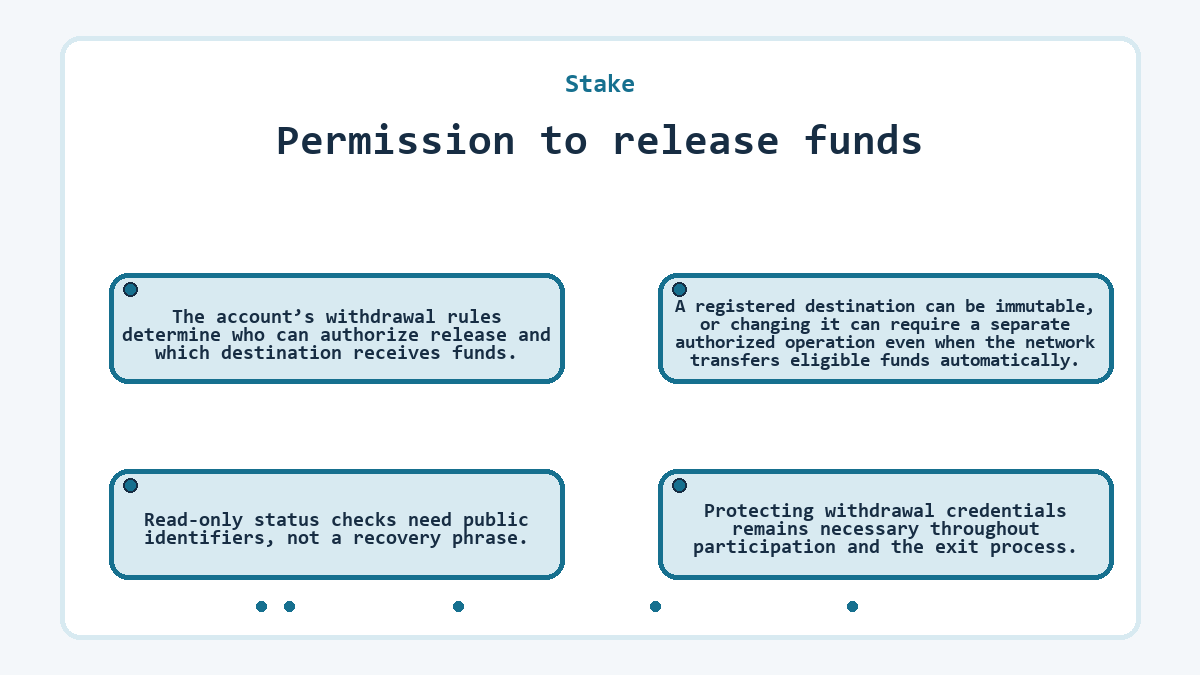
The account’s withdrawal rules determine who can authorize release and which destination receives funds. A registered destination can be immutable, or changing it can require a separate authorized operation even when the network transfers eligible funds automatically. Read-only status checks need public identifiers, not a recovery phrase. Protecting withdrawal credentials remains necessary throughout participation and the exit process.
Exit submission and the end of duties
An accepted exit request records the intention to leave participation, while the effective exit state determines when validator duties end. A validator in an exit queue can remain active until its scheduled boundary. Its operator must maintain required duties during that interval. Delegation systems can move the selected amount into an unbonding entry. Read the affected position and amount; an exit affecting part of a commitment need not end participation for the remainder.
The reward cutoff follows the selected network’s transition rules. Submission time alone does not establish the last earning interval. Record the effective exit or unbonding state and compare it with subsequent reward accounting. Where delayed slashing applies, validator misconduct during bonded participation can reduce tokens already in unbonding. Stopping validator software before the active duties end can cause missed duties and applicable penalties.
Withdrawal eligibility and final delivery
Withdrawal eligibility establishes permission to release tokens, while a completed transfer establishes the balance available at the intended destination. Unbonding, withdrawal processing and pool redemption can impose separate conditions. Where account lockups apply, an unexpired lockup can prevent withdrawal after delegation becomes inactive. Some networks transfer eligible funds automatically; other methods require an authorized withdrawal operation. The recorded position identifies whether further action remains necessary.
A pool’s redemption request can also wait for available liquidity or underlying validator exits. The request establishes pending redemption; delivery requires recorded settlement and the resulting recipient balance. Trading a liquid staking token transfers that token to a buyer; it does not itself exit the underlying validators. The received trading amount can differ from its redemption value. For final reconciliation, distinguish withdrawn principal, separately delivered rewards and any fee the operation charges. Match the actual recipient and asset with the completed record, since a pending amount remains a claim awaiting settlement.
Stalled transitions and bounded recovery
Recovery starts with identifying the last state the network actually recorded and the condition blocking the next transition. First establish whether the network accepted the operation, using its recorded status and resulting position. If execution failed, inspect its error and the position’s recorded state before correcting the operation. If the commitment exists, investigate activation conditions without assuming submission failed. If exit has taken effect, inspect withdrawal eligibility and delivery. Compare views of the same network at compatible confirmation levels; a stale interface can lag behind the ledger.
An explorer outage limits visibility. Another synchronized view can restore it, while repeating an already successful funding or delegation operation in a new transaction can create an additional commitment.
Protocol waiting periods and account permissions bound recovery. Repeating an accepted request does not bypass a required waiting period. An incorrect assignment needs a supported reassignment or exit operation, while lost credentials require a recovery path the account supports. A public record alone does not grant signing authority.
What readers ask about Stake
-
Which timestamp marks the start of a staking waiting period?
- The protocol’s recorded transition determines the start of a staking waiting period. A local signing time or interface notification can precede network acceptance. Some systems store a completion timestamp; others use an epoch or scheduled activation boundary. Keep the relevant network record rather than calculating a deadline from the moment you clicked.
-
Is an accepted staking exit reversible?
- Reversibility depends on the specific exit operation. Some delegation systems support cancellation of eligible pending unbonding entries, while a validator’s accepted voluntary exit can be irreversible. Removing a request from an interface does not undo its network state. Where cancellation exists, its recorded result must show the restored commitment or updated pending amount.
-
How can I inspect progress without a staking dashboard?
- A network node can expose the stored position through its supported query interface. Depending on the method, query the validator, staking account, delegation or unbonding entry using its public identifier. Request a suitable confirmation level and distinguish an unavailable response from a recorded failure. A node lacking historical data may not return an older transaction.
-
What happens to the fee after a staking transaction fails?
- A failed included transaction can still incur a network fee. Some protocols revert the operation’s state changes while charging for transaction processing. A submission rejected before inclusion has a different status. Inspect the execution result and recorded fee; a smaller wallet balance alone does not prove the staking operation succeeded.
-
Do multiple deposits always create separate staking positions?
- Multiple deposits can enlarge an existing position or create distinct positions, depending on the account structure. A delegation can aggregate tokens assigned to the same validator, while separate staking accounts maintain distinct records. Track the identifiers the ledger actually stores. Counting deposit transactions does not determine how many active positions exist.
-
Why can claimable rewards decrease after adjusting a delegation?
- Some delegation systems automatically withdraw accrued rewards when the delegation changes. The claimable balance then reflects rewards remaining after that distribution. Inspect the designated reward recipient and the operation’s recorded transfers before treating the reduction as a loss. The same mechanism can reset the accounting period used to calculate subsequent rewards.
-
Can one staking transaction contain several operations?
- A transaction can contain several supported staking operations when the network’s transaction format allows them. Funding and delegation therefore need not always require separate submissions. Each operation retains its own eligibility conditions, and successful execution does not bypass a later activation period. The resulting account state establishes which changes actually took effect.
Last updated -