 Stake
Stake Stake rewards and the records that verify earnings
Stake rewards are token earnings from eligible proof-of-stake participation, and their records distinguish estimates from credited amounts. Verification starts with the position earning the reward, the accounting period and the receiving account or claimable reward entry. Match those details to the applicable reward rule, including validator performance, commissions and any activation requirements. The initial deposit record confirms principal entering the staking position. Reward entries or pool accounting can establish what the position earned. Available funds, claimable rewards and value represented by pool tokens require different readings. The next action follows the recorded state: wait for scheduled accounting, inspect a missing credit or claim funds where the method requires a claim.
Bottom line: Reward payments and claim fees need separate entries, even when both affect the same spendable token balance.
Credited rewards and delayed wallet updates
A normal reward credit appears in the relevant account or reward ledger once the earning period and its distribution rules permit it. The record identifies the credited amount and the period or event it covers. A wallet display can lag behind those records. If the underlying ledger already shows the credit, refreshing the display addresses the reporting mismatch. Repeating a staking deposit does not repair a stale reward display or establish another reward payment.
A display problem needs a data refresh. An absent ledger credit needs an eligibility or accounting check before any new transaction.
Eligible stake, custody and withdrawal restrictions
Rewards apply to the balance the selected staking mechanism counts as eligible, which may differ from the total balance a wallet displays. Native validation or delegation can require active status and a validator qualifying under network rules. Pending activation can therefore explain a period without rewards. The supported input might be the network’s staking asset or an existing eligible stake position, depending on the method. The position record needs to identify the accepted input and its earning status. Tokens outside the eligible balance do not acquire eligibility merely because the wallet groups them with active stake.
Staking can also change control or availability according to the chosen method. Native delegation does not necessarily transfer custody to the validator. Apply any lockup or withdrawal restriction to the balance it governs, including rewards only where the rules specify. Ownership of a position and permission to spend its tokens remain separate questions.
Reward funding, deductions and changing rates
The source of a reward determines which records explain it: protocol issuance, distributed transaction revenue or a provider’s separately funded incentive. Protocol rules determine which revenue reaches participants. Fees the network burns do not become a credit to a staking account. A separate incentive also needs its own eligibility and payment terms.
Validator performance can affect staking rewards. Missed duties can reduce earnings; applicable penalty rules may also reduce principal. Match the validator’s status to the earning period. Its present status cannot establish how it performed during an earlier period.
A validator commission may apply to earned rewards, while a pool or custodian can impose its own charges. Record the calculation basis before subtracting anything. A net credited amount already includes deductions the mechanism made. Subtracting those deductions again understates earnings. Historical calculations need the commission or fee applicable to that period.
Annualized estimates describe a calculation over time. Changing eligible stake, network issuance or fee settings can change subsequent earnings.
What proves a staking reward reached the receiving account?
A confirmed reward record identifies the credited asset, amount and receiving account, with the resulting balance supporting the same payment within its accounting scope. For a submitted claim, inspect successful execution and the actual reward credit. A signature records authorization; a tracking identifier supports a status lookup. Neither establishes delivery alone. Automatic distributions can appear as protocol reward or withdrawal entries without a user-submitted claim transaction. Use the confirmation state the network requires when comparing the record with the receiving balance.
The destination may differ from the account controlling the stake. Follow the recorded withdrawal or payout destination before calling a payment missing. A deposit into a staking position moves principal; its receipt cannot establish a later reward payment.
A reward claim and its fee balance
This hypothetical claim concerns separately accrued delegation rewards, with the receiving account paying its own fee from spendable funds before execution. The active position has 0.482 native tokens ready to withdraw after commission. The designated receiving account holds 1.732 spendable native tokens and pays a fee of 0.007 native tokens. There is no fee sponsor or other transfer during the claim.
Before signing, confirm the claimable entry, the permitted claim signer and the recorded destination. The available 1.732 tokens cover the 0.007-token fee. A submitted claim still needs a successful execution record; authorization and submission alone do not establish receipt.
In the completed claim, the payment record confirms a credit of 0.482 tokens and a fee of 0.007 tokens. The receiving balance becomes 2.207 tokens: 1.732 + 0.482 - 0.007 = 2.207. The reward payment is 0.482 tokens; the spendable balance increases by 0.475 tokens after the claim fee. The delegated principal remains in the position.
If the account held only 0.004 spendable tokens, it would lack the 0.007-token fee required before execution. Funding the spendable fee balance resolves that prerequisite. Claimable rewards cannot prepay the fee under this method. A different final fee or credited reward would change the arithmetic.
Reconcile balances without counting principal as income
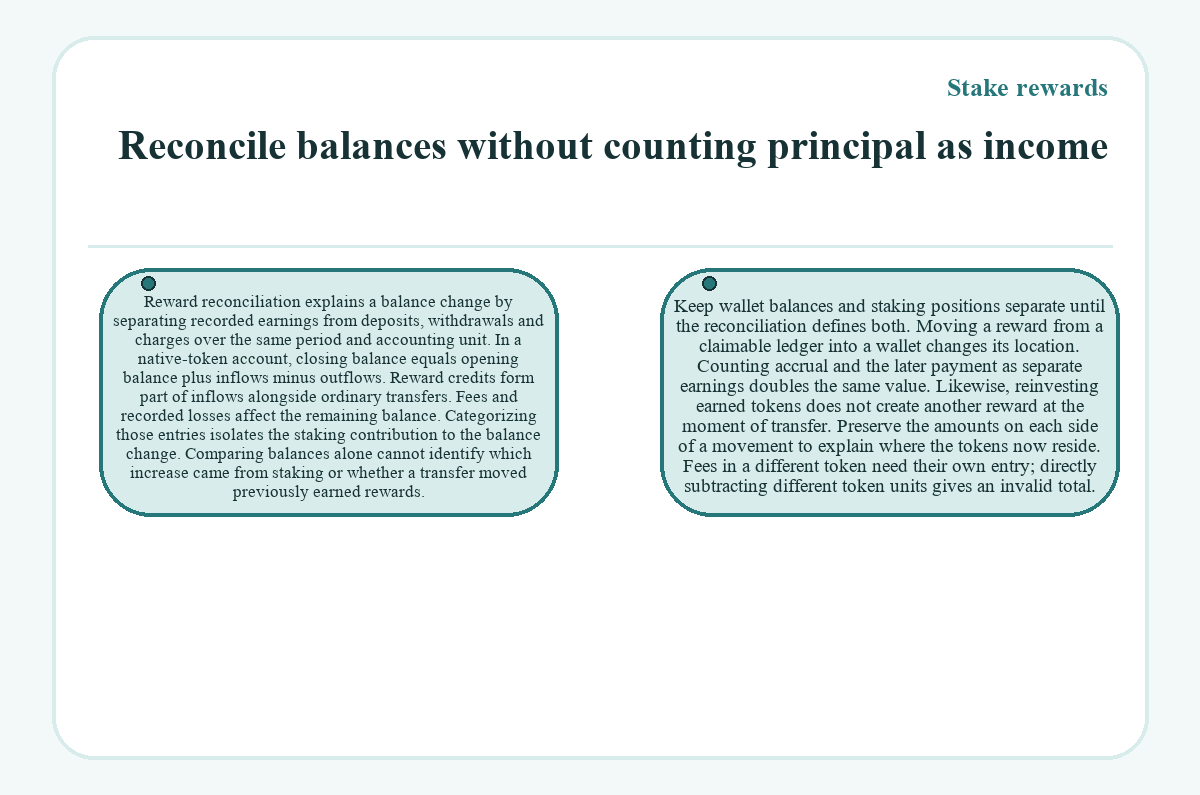
Reward reconciliation explains a balance change by separating recorded earnings from deposits, withdrawals and charges over the same period and accounting unit. In a native-token account, closing balance equals opening balance plus inflows minus outflows. Reward credits form part of inflows alongside ordinary transfers. Fees and recorded losses affect the remaining balance. Categorizing those entries isolates the staking contribution to the balance change. Comparing balances alone cannot identify which increase came from staking or whether a transfer moved previously earned rewards.
Keep wallet balances and staking positions separate until the reconciliation defines both. Moving a reward from a claimable ledger into a wallet changes its location. Counting accrual and the later payment as separate earnings doubles the same value. Likewise, reinvesting earned tokens does not create another reward at the moment of transfer. Preserve the amounts on each side of a movement to explain where the tokens now reside. Fees in a different token need their own entry; directly subtracting different token units gives an invalid total.
Reward records for native stake and pool holdings
Native staking records identify the earning position directly, while pool holdings require the pool’s accounting to connect your balance with the underlying stake. Validator or delegation records link the participant to the eligible position and its reward entries. A pool’s aggregate reward figure describes the pool, so personal attribution also requires the holder’s entitlement under its distribution rules.
Some staking pool tokens represent rewards through an increasing redemption value per token. For those holdings, a fixed token count does not establish zero earnings. Other designs increase token balances through rebasing. Compare holdings at matching accounting points and separate transfers from reward-driven changes. A secondary-market quote describes a potential sale value; it does not establish the pool’s redemption accounting or prove realized rewards.
A custodial provider’s statement describes credits to the customer’s account. Provider terms determine the reward calculation and access to those credits. A provider deposit address can combine several customers’ funds, so network activity alone cannot attribute individual earnings. That attribution needs the customer ledger and its relationship to the staking activity. When the relationship is opaque, a statement can confirm a reported customer credit without independently proving the underlying validator work.
Monitor later credits and preserve exit evidence
Ongoing checks compare reward periods, validator status and applicable fees, while exit records identify when the position stops qualifying under the selected method. Operators must continue required validator duties while their positions remain active. Preserve the final reward entry and the withdrawal or redemption credit. A payment after an exit request may settle an earlier earning period. Match any remaining claimable amount to the exit state to decide whether the next action concerns rewards or released principal.
Helpful answers about Stake rewards
-
Which token unit should I use when comparing a reward export with a wallet?
- Compare amounts in the same token unit and decimal scale. A raw ledger export may use the token’s smallest unit, while a wallet displays whole-token decimals. Convert using the asset’s defined scale and retain precision until reconciliation ends. Different display rounding can otherwise create an apparent discrepancy.
-
Does a blank historical reward query prove that I earned nothing?
- Missing reward data does not establish a zero reward. A query may return no available record for the requested address or period. Keep an explicit zero separate from an unavailable result, and check the query’s historical coverage before using it in an earnings total.
-
Are credited token rewards erased when their market value falls?
- A price decline does not reverse a token reward already credited to an account. Token earnings and changes in market valuation describe different quantities. A credited reward can coexist with a decline in the position’s total market value. Monetary performance also reflects price movement and costs.
-
Can transferred pool tokens make my reward history look larger than it is?
- An incoming transfer of pool tokens can increase holdings without creating new staking rewards. Those tokens carry an existing claim on the pool. Keep the acquisition separate from rewards attributable to the holding period, especially when a dashboard estimates earnings from changes in the wallet’s total balance.
-
Is a matching ticker enough to identify a staking reward payment?
- A matching ticker alone does not identify a staking reward. Token symbols can repeat across assets or networks. Match the network and the asset identifier applicable to the staking position, then connect the credit to its reward record. An unrelated transfer with the same symbol does not prove earnings.
-
How should split reward payments appear in an earnings record?
- Record each distinct credited payment once and retain its associated reward period or distribution event. Several entries may contribute to one period’s total. Keep any summary total separate from the component payments so an export does not count the same reward twice.
-
What records attribute rewards when several participants share a staking address?
- A shared address needs a separate allocation ledger to attribute rewards to individual participants. Public transaction and reward records show the address’s activity, while ownership shares or provider account records establish each entitlement. Keep those allocations consistent with the total credited amount and the applicable deductions.
Last updated -